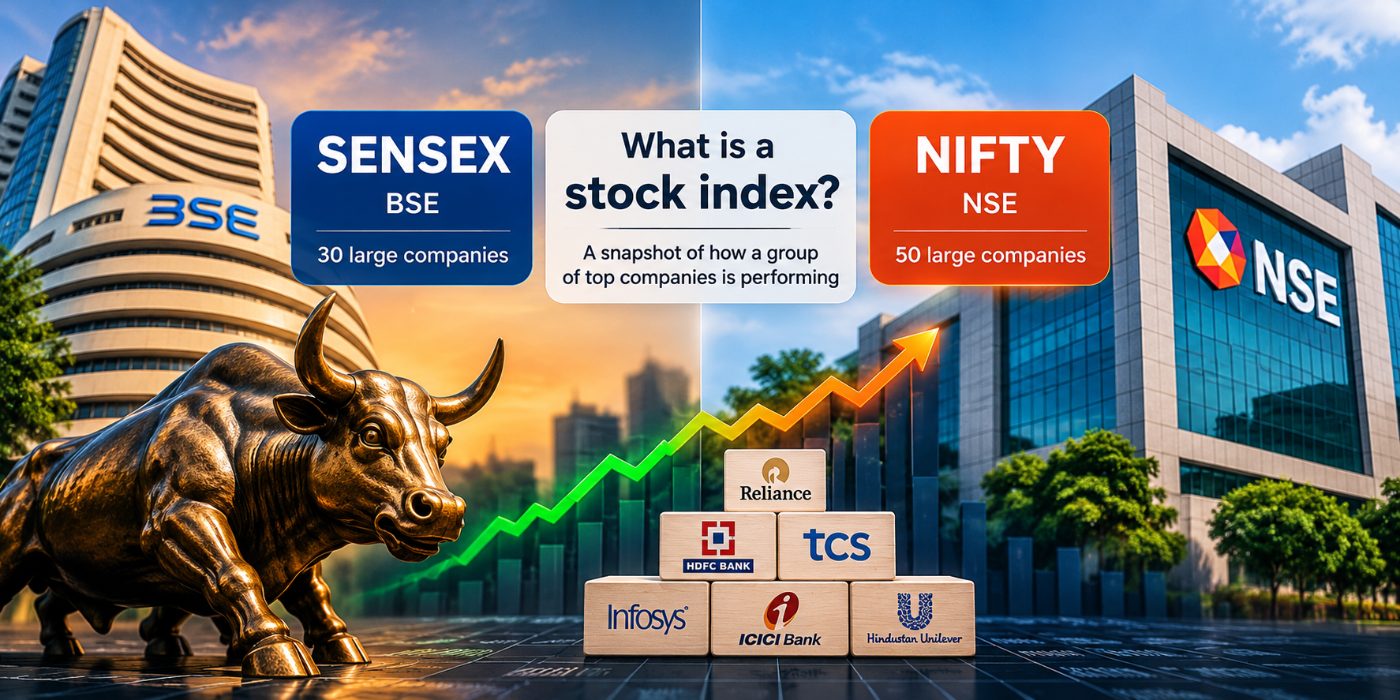
Every evening the news says "the Sensex rose 300 points" or "the Nifty closed higher." But what is actually going up? A stock index isn't a share you can buy — it's a scorecard that tracks a basket of companies, so one number tells you how the market did. Here's how it works, and what the Sensex, Nifty and their cousins really measure. This is for learning only.
What an index really is
An index picks a fixed basket of stocks and tracks their combined value over time, scaled to a round starting number. When the basket rises on average, the index rises. Because bigger companies move the economy more, most indices are market-cap weighted — a giant like Reliance moves the number far more than a small company does.
Sensex vs Nifty
- The Sensex is the BSE's index of 30 large, established companies. It's the older benchmark, launched in 1979 with a base value of 100.
- The Nifty 50 is the NSE's index of 50 large companies, launched in 1996 with a base of 1000.
They overlap heavily and usually move together — on most days, if one is up, so is the other. The Nifty is simply broader (50 names vs 30) and is the index most derivatives and index funds track.
The rest of the Nifty family
Beyond the headline 50, the market is sliced by company size:
| Index | What it covers (by market-cap rank) |
|---|---|
| Nifty 50 | The 50 largest companies |
| Nifty Next 50 | The next 50 (ranks 51–100) — tomorrow's large-caps |
| Nifty 100 | The two above combined — the full large-cap universe |
| Nifty Midcap 150 | Ranks 101–250 |
| Nifty Smallcap 250 | Ranks 251–500 |
| Nifty 500 | The top 500 — over 90% of listed market value |
This ladder matters because risk rises as you go down it: small-caps can climb faster in a boom and fall harder in a slump. It also lines up with how funds are labelled — see large-cap, mid-cap and small-cap.
Why the index matters to you
- It's the benchmark — every fund or strategy is judged against it. Beating "the market" means beating an index like the Nifty.
- You can buy the index itself cheaply through an index fund or ETF instead of picking stocks — see index funds vs active funds.
- It's a quick read on mood and direction — though a single index hides how individual stocks are doing underneath.
The takeaway: the Sensex and Nifty aren't stocks, they're scorecards — and knowing which basket each measures tells you exactly what the day's "market" number is saying. A disciplined, rule-based approach like our Model Portfolio is ultimately about trying to add value over a benchmark like this, with risk fixed in advance.

India VIX: what the market’s ‘fear gauge’ is really telling you
When markets panic, one number spikes — India VIX. What the volatility index measures, what its levels mean, and why it's called the fear gauge.

How a stock's price is actually set
Nobody "fixes" a share price — it's decided every second by buyers and sellers. How the order book really works, in plain words.

Large-cap, mid-cap, small-cap: what they mean for you
These labels decide how safe or risky a stock is. What market cap really means, the exact 2026 cut-offs, and how to use them.
Comments
Loading…