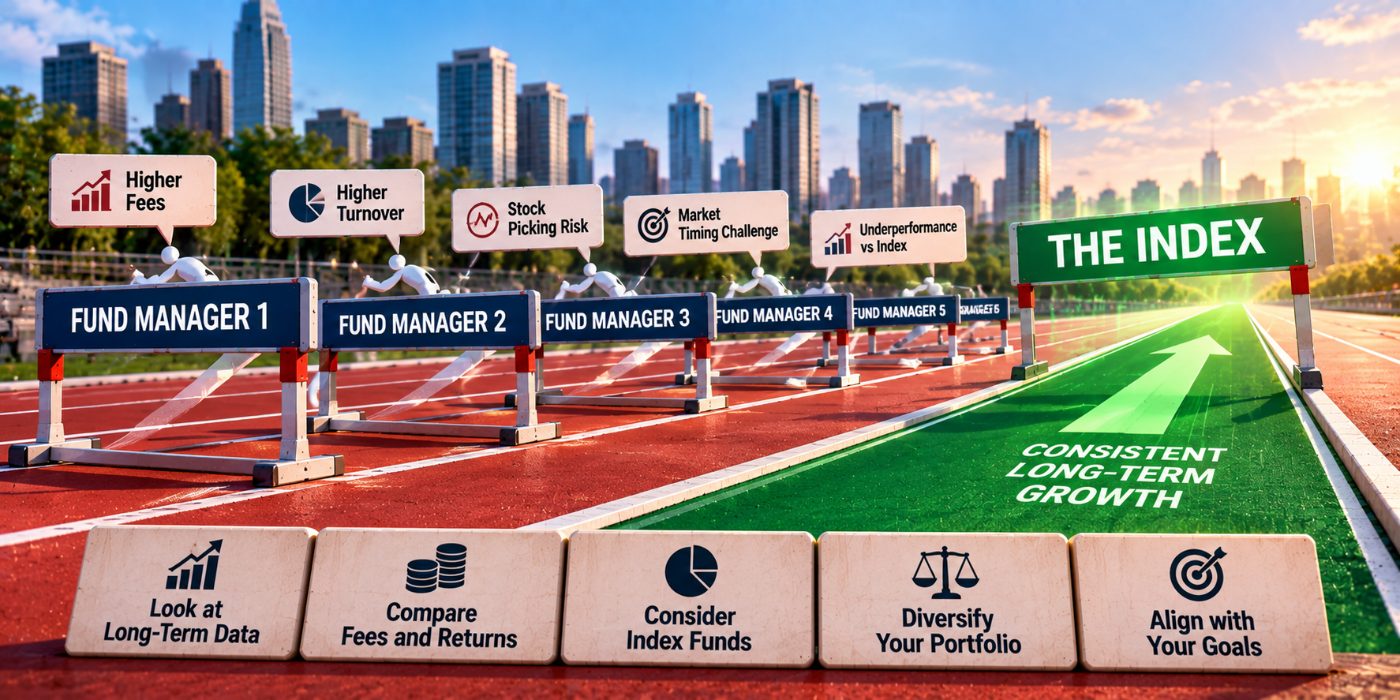
Here is one of the most important questions in investing — and it has a clear, data-backed answer most people never hear. Should you pay an expert fund manager to try and beat the market (an active fund), or simply buy the whole market cheaply (an index fund)? This is for learning only.
The two choices, simply
- An active fund has a manager who picks stocks, trying to beat a benchmark like the Nifty 50. You pay more for that effort.
- An index fund just copies an index — the same 50 stocks as the Nifty, in the same proportions. No star manager, no stock-picking, and a very low fee.
What the SPIVA data actually says
Every year, a global study called the SPIVA India Scorecard (run by S&P) checks how many active funds actually beat their benchmark. The results are humbling for active management. For the period ending December 2025, the share of Indian large-cap active funds that underperformed their index was:
| Over this period | % of large-cap active funds that LOST to the index |
|---|---|
| 1 year | about 75% |
| 3 years | about 74% |
| 5 years | about 84% |
| 10 years | about 76% |
Read the five-year line again: roughly 5 out of 6 large-cap active funds failed to beat a simple index. And it doesn't get easier with time — the longer the period, the harder consistent outperformance becomes. Paying more for an expert, most of the time, bought worse results.
Why does the cheap option win?
- Cost — the big one (next section).
- It's genuinely hard to beat the market consistently, because professional managers collectively are most of the market. They can't all be above average.
The fee that quietly decides it
An index fund's yearly fee (expense ratio) is tiny — around 0.1–0.5%. A typical active fund charges around 1.5–2%. That gap sounds trivial. It isn't. On the same investment over 20 years, moving from a 2% active fund to a ~0.5% index fund can mean a difference of over ₹35 lakh. The fee doesn't just cost you the fee — it costs you all the compounding that money would have earned. More on this in mutual funds and the fees that cost you lakhs.
So should you only buy index funds?
Not necessarily. Some active funds and disciplined rule-based strategies do add value, and in the mid- and small-cap space the gap is often smaller. But the honest default for most investors is simple: a low-cost index fund is very hard to beat, and it outperforms the majority of expensive funds over time. If you do choose an active approach, make sure it is genuinely different and disciplined — a transparent, rule-based process — not just an expensive version of the index.
The deeper lesson isn't "index good, active bad." It's that cost, discipline and staying invested matter more than chasing last year's winner — the same spirit behind our rule-based Model Portfolio.
Comments
Loading…