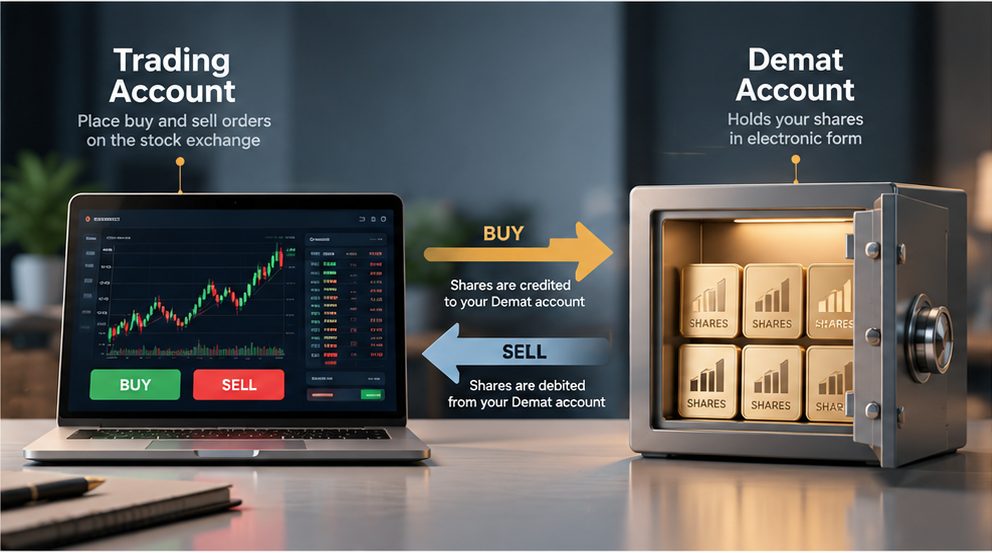
Before you buy a single share, you need two accounts — and most beginners don't know the difference. Get this right and you'll never overpay in hidden charges again. This is for learning only.
Two accounts, two jobs
- A trading account is where you place orders — buy and sell. Think of it as the remote control.
- A demat account is where your shares are stored, safely in electronic form. Think of it as the locker.
When you buy, the trading account sends the order; when it's done, the shares land in your demat account. Most brokers open both together in one go.
Your shares are actually held by one of two depositories — NSDL or CDSL — not by the broker. That's a safety feature: even if your broker shuts down, your shares are safe with the depository. By 2026, India had crossed 23 crore demat accounts.
What it costs — the honest list
Opening an account is usually free today. The charges that matter are:
- Account maintenance (AMC): Thanks to a SEBI rule from September 2024, if your total holdings stay under ₹4 lakh, you can have a Basic Services Demat Account (BSDA) with zero AMC. Between ₹4 lakh and ₹10 lakh, the charge is just ₹100 a year. Above ₹10 lakh it becomes a regular account with normal AMC (often ₹300–₹750 a year).
- Brokerage: Many discount brokers charge ₹0 on delivery (shares you buy and hold) and a flat ₹20 per order for intraday and F&O. Full-service brokers charge a percentage, which works out much higher.
- Small statutory charges on every trade: STT (securities transaction tax), GST, stamp duty, and DP charges (roughly ₹13–₹25 per company when you sell). These are tiny but real.
How to pick, simply
- If you buy and hold, a discount broker with ₹0 delivery and a BSDA can cost you almost nothing a year.
- Check the broker is registered with SEBI and is a member of NSE/BSE.
- Beware "free" apps that nudge you to trade constantly — the real cost of investing is usually not the fee, it's over-trading.
If you're just getting started, read how to start investing in the stock market next. The account is just the doorway — what you do after you walk through it is what builds wealth.

What the stock market is and why it exists
What is the stock market, really? In the simplest words — how it works, why it exists, and the real numbers behind India's markets.

Primary market vs secondary market: the difference
Where does your money actually go when you buy a share? The simple difference between the primary and secondary market — with real examples.

Risk, return and the magic of compounding
Why ₹1 lakh can quietly become ₹32 lakh — and why higher return always comes with higher risk. The two ideas that decide your wealth.
Comments
Loading…