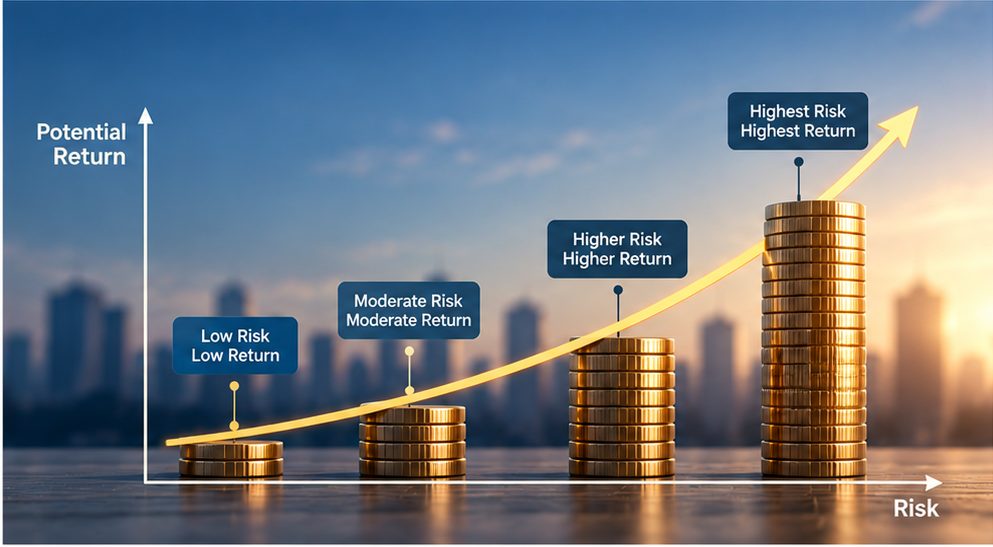
There are only two ideas you truly need to understand before investing: risk vs return, and compounding. Master these and most of investing falls into place. This is for learning only.
Return and risk always travel together
Nobody gives you a higher return for free. The rule is simple: the higher the possible return, the higher the risk. Rough long-term averages in India look like this:
| Where you put money | Rough long-term return | Risk |
|---|---|---|
| Savings account | 3–4% | Almost none |
| Fixed deposit | 6–7% | Very low |
| Gold | 9–10% | Medium |
| Equity (stocks / Nifty 50) | ~12% | Higher, ups and downs |
If anyone promises you "high returns, no risk," that is the single clearest sign of a scam. (Past averages are not a promise of future returns.)
Compounding — earning returns on your returns
Compounding means your gains start earning their own gains. A quick trick to feel it is the Rule of 72: divide 72 by your yearly return to see how many years money takes to double. At 12%, that's 72 ÷ 12 = 6 years to double.
Watch what that does to ₹1 lakh left untouched at 12%:
| Years | Value of ₹1 lakh |
|---|---|
| 6 | ₹2 lakh |
| 12 | ₹4 lakh |
| 18 | ₹8 lakh |
| 24 | ₹16 lakh |
| 30 | ₹32 lakh |
The last doubling (₹16 lakh → ₹32 lakh) adds more than all the earlier ones combined. That's why compounding rewards time more than cleverness.
Why starting early beats investing more
Two friends each invest ₹5,000 a month at 12%. Riya starts at 25, Rahul at 35. By age 60:
- Riya (35 years) ends with roughly ₹3.2 crore.
- Rahul (25 years) ends with roughly ₹95 lakh.
Riya invested only ₹6 lakh more than Rahul over her life — but ended with over three times the wealth. The difference is simply time in the market.
The lesson: pick a level of risk you can live with, start early, and let compounding do the heavy lifting. That patient, rule-based approach is the whole idea behind our Model Portfolio — own good businesses and give them time, rather than jumping in and out.

What the stock market is and why it exists
What is the stock market, really? In the simplest words — how it works, why it exists, and the real numbers behind India's markets.

Demat and trading account: how they work and what they cost
You need two accounts to invest — and they do different jobs. What a demat and trading account are, and exactly what they cost in 2026.

Primary market vs secondary market: the difference
Where does your money actually go when you buy a share? The simple difference between the primary and secondary market — with real examples.
Comments
Loading…