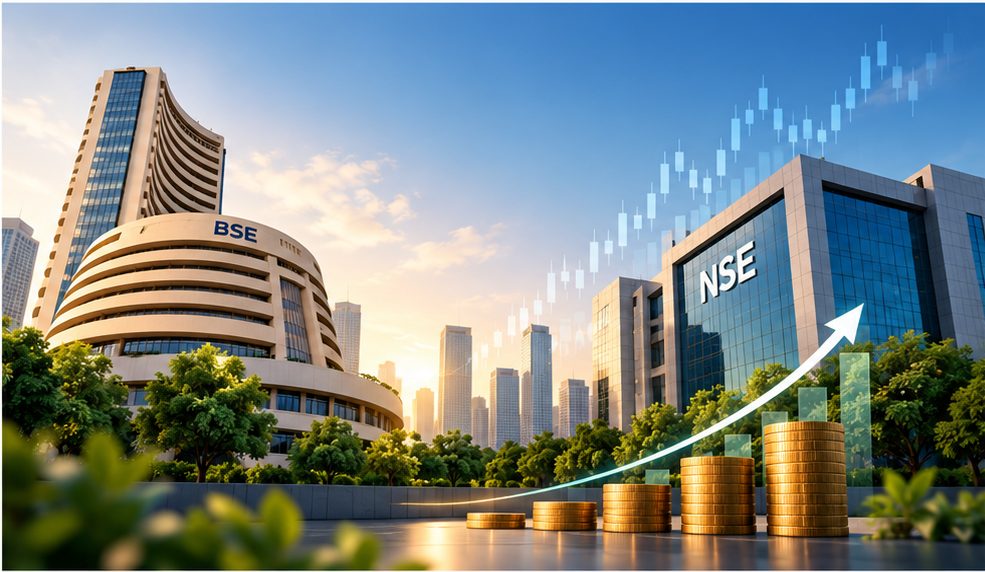
When you buy a share, you buy a tiny piece of a company. That simple idea powers one of the biggest wealth-building machines in the world. But what IS the stock market, and why does it even exist? Let's keep it very simple. This is for learning only.
Why the stock market exists
Companies need money to grow — to build factories, hire people, open new stores. Instead of borrowing all of it from banks, a company can sell small pieces of itself — called shares — to the public. In return, you become a part-owner and share in the company's future. The stock market is simply the place where these pieces are bought and sold.
So the market does two big jobs:
- It helps companies raise money to grow — this happens in the "primary market," through an IPO.
- It lets investors buy and sell those shares easily afterwards — this is the "secondary market," the day-to-day trading you see on screens.
How big is it?
India has two main exchanges — the NSE and the BSE. Around 2,800 companies are listed on the NSE alone, and more than 7,800 across both exchanges together. And more Indians are investing than ever: by 2026 there were over 23 crore demat accounts (the account that holds your shares electronically) — many times what it was a decade ago.
How a share actually makes you money
Two ways:
- The price goes up. Buy a share at ₹100, and if the business does well and it rises to ₹150, your piece is worth more.
- Dividends. Many companies share part of their profit with owners as a cash payout.
But prices also fall. A share is ownership in a real business — and businesses do well or badly. That is the risk, and it is why the market rewards patience and punishes gambling.
Who's who in the market
- Investors — people like you, plus big institutions (mutual funds, pension funds, foreign funds).
- Exchanges (NSE, BSE) — the marketplaces where trades happen.
- Depositories (NSDL, CDSL) — they hold your shares safely in electronic form.
- SEBI — the regulator that makes the rules and protects investors.
- Brokers — the apps and firms that let you place orders.
Why it matters for your wealth
Over the long run, owning a slice of growing businesses has been one of the best ways to beat inflation. India's benchmark index, the Nifty 50 (the 50 largest companies), has returned roughly 12% a year on average over the long term — at that rate, money roughly doubles every six years. That is the quiet power the market offers, if you treat it as part-ownership of real businesses rather than a lottery ticket.
That is exactly the philosophy behind our Model Portfolio — owning a disciplined basket of businesses by rule, not chasing tips. If you're just starting out, read how to start investing in the stock market next.
The stock market, in the end, is not a casino — it's a way for ordinary people to own a piece of the economy's growth. Understand that one idea, and you've already avoided the biggest mistake most beginners make.

Demat and trading account: how they work and what they cost
You need two accounts to invest — and they do different jobs. What a demat and trading account are, and exactly what they cost in 2026.

Primary market vs secondary market: the difference
Where does your money actually go when you buy a share? The simple difference between the primary and secondary market — with real examples.

Risk, return and the magic of compounding
Why ₹1 lakh can quietly become ₹32 lakh — and why higher return always comes with higher risk. The two ideas that decide your wealth.
Comments
Loading…