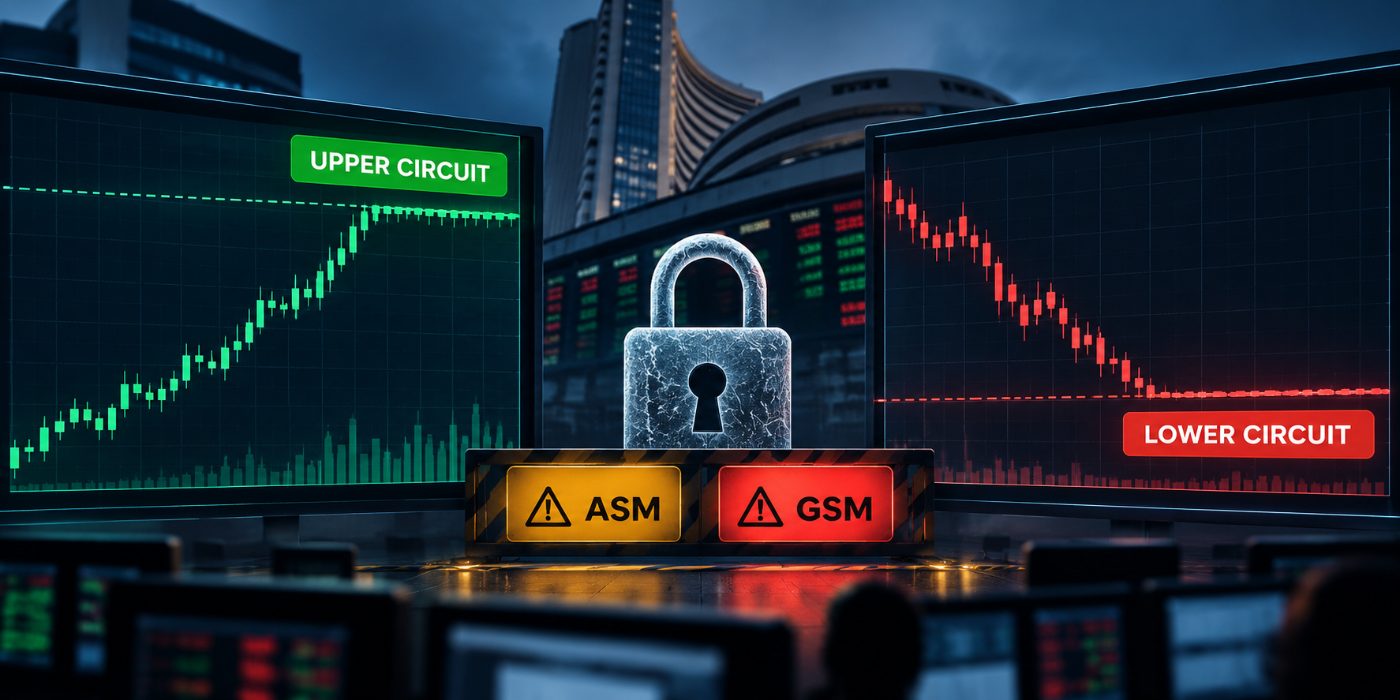
Occasionally a stock — or the entire market — just stops. Buyers can't buy, sellers can't sell, and prices won't budge. It has hit a circuit breaker. There are two kinds: limits on a single stock, and market-wide halts that freeze everything. Understanding both, and the surveillance lists behind them, tells you a lot about risk. This is for learning only.
Stock-level circuits: the daily price band
To curb wild swings and manipulation, exchanges cap how far a single stock can move in a day — its price band, measured from the previous day's close. Common bands are 2%, 5%, 10% or 20%, depending on the stock. Hit the top of the band and it's "locked in upper circuit" (only buyers, no sellers); hit the bottom and it's "locked in lower circuit" (only sellers, no buyers).
Not every stock has a fixed band. Large stocks that trade in the derivatives (F&O) segment and the big index names generally have flexible or dynamic bands that the exchange can widen through the day, so that genuine price discovery and derivatives trading aren't blocked. The tight 2%/5% bands are mostly reserved for smaller, more easily manipulated stocks — which is exactly where the danger lies.
Why a lower circuit is dangerous
A stock locked in lower circuit is a trap: everyone wants out and there are no buyers. The price can fall by its band limit day after day while you simply cannot sell. This is why thinly traded and manipulated stocks are so hazardous — see the real risks of penny stocks.
Market-wide circuit breakers: when the whole market halts
Separately, the entire market has its own safety brake. A market-wide circuit breaker is triggered by a big move in the benchmark index — measured on either the Sensex or the Nifty 50, whichever breaches the level first, and calculated from the previous day's close. There are three trigger levels: 10%, 15% and 20%.
Here's the part most people don't know: how long trading halts depends on both the level breached and the time of day it happens — because a shock in the first hour is treated very differently from one near the close.
| Index falls/rises by | If triggered before 1:00 pm | Between 1:00 pm and 2:30 pm | At or after 2:30 pm |
|---|---|---|---|
| 10% | 45-minute halt | 15-minute halt | No halt — trading continues |
| 15% | 1 hour 45-minute halt | 45-minute halt (if before 2:00 pm) | At/after 2:00 pm: closed for the rest of the day |
| 20% | Trading halted for the rest of the day, whenever it is triggered | ||
The logic is simple: a 10% fall late in the day leaves little time to do damage, so trading just carries on; the same fall in the morning triggers a cooling-off pause. A 20% move is treated as a full-blown crisis and shuts the market for the day no matter when it strikes.
What happens after a halt
When trading is halted and then resumes, it doesn't just switch back on. There's a 15-minute pre-open call auction first, where buy and sell orders are collected and a fresh opening price is discovered in an orderly way — preventing a chaotic restart. Only after that does normal trading resume.
ASM and GSM: the surveillance lists
Beyond circuits, when a stock shows unusual price or volume behaviour the exchanges place it under ASM (Additional Surveillance Measure) or GSM (Graded Surveillance Measure). In practice that can mean higher margins, tighter price bands, periodic call auctions instead of continuous trading, or being shifted to trade-to-trade settlement (where you must take delivery — no intraday). It's the exchange flashing a caution light over a name.
What it all means for you
A stock that regularly hits circuits, or one sitting under ASM/GSM, is telling you it's volatile, illiquid or under watch — that's a reason for extra care, smaller size, and deep scepticism of any "hot tip." And knowing the market-wide breakers means that on a brutal day you won't panic when the screen freezes: it's a deliberate, temporary pause designed to let everyone catch their breath, not the market vanishing.
Liquidity — the ability to get out when you want — is a core filter in any disciplined process, including our rule-based Model Portfolio. If a name can't be exited cleanly, it doesn't belong in the book.

India VIX: what the market’s ‘fear gauge’ is really telling you
When markets panic, one number spikes — India VIX. What the volatility index measures, what its levels mean, and why it's called the fear gauge.

How a stock's price is actually set
Nobody "fixes" a share price — it's decided every second by buyers and sellers. How the order book really works, in plain words.

Large-cap, mid-cap, small-cap: what they mean for you
These labels decide how safe or risky a stock is. What market cap really means, the exact 2026 cut-offs, and how to use them.
Comments
Loading…