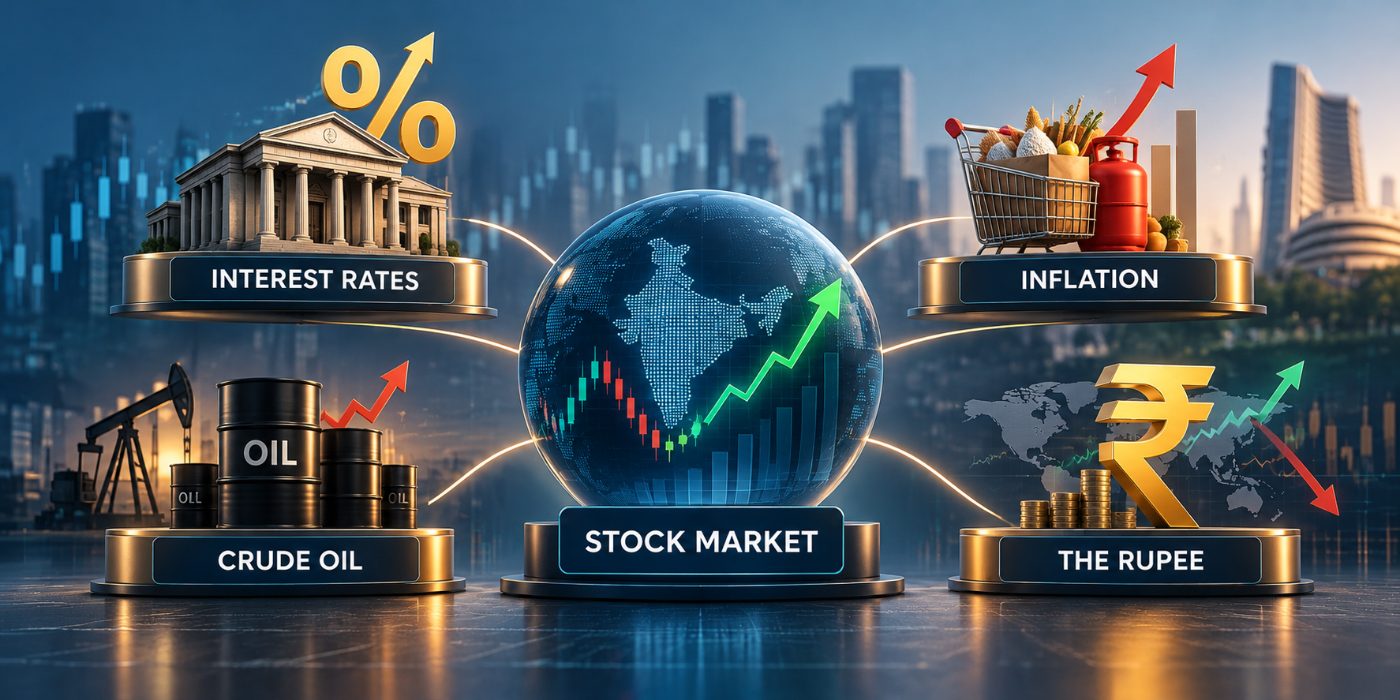
Some days the whole market rises or falls together, no matter what any single company did. That's the work of big-picture forces. Here are the four that matter most — in plain words, with real 2026 numbers. This is for learning only.
1. Interest rates (the RBI's repo rate)
The repo rate is the rate at which the RBI lends to banks. In October 2026 it stood at 5.25%.
- Lower rates → loans are cheaper → companies and people spend and borrow more → usually good for stocks. Fixed deposits also pay less, nudging money toward equity.
- Higher rates → borrowing costs more → spending slows → usually a headwind for stocks.
2. Inflation (how fast prices rise)
Inflation is measured by the CPI. In August 2026 it was about 4.82%. The RBI's job is to keep it near 4% (within a 2–6% band).
- High inflation eats your money's value and often forces the RBI to raise rates — a double negative for markets.
- Moderate, steady inflation is normal and healthy.
3. Crude oil
India imports most of the oil it uses, so the global crude price matters a lot. In 2026, Brent crude traded in the high-$90s a barrel.
- Costly oil → higher petrol, diesel and transport costs → higher inflation → pressure on the rupee and on company profits.
- It especially hurts oil-using sectors (paints, airlines, tyres) and helps oil producers.
4. The rupee (USD/INR)
In 2026 the rupee traded around ₹96 to one US dollar.
- A weaker rupee (needs more rupees per dollar) helps exporters — IT and pharma earn in dollars — but hurts importers and raises the cost of oil and foreign goods.
- A stronger rupee does the reverse.
How they fit together
These forces are linked in a chain: costly oil → higher inflation → RBI raises rates → borrowing slows → markets wobble, rupee weakens. You don't need to predict them. You just need to understand that when the market moves for "no reason," one of these four is usually behind it.
The takeaway for an everyday investor: don't panic on macro headlines. These forces move in cycles and even out over years. A long-term, rule-based plan is designed to ride through them — which is the whole point of investing by process rather than by mood.

How a stock's price is actually set
Nobody "fixes" a share price — it's decided every second by buyers and sellers. How the order book really works, in plain words.

Large-cap, mid-cap, small-cap: what they mean for you
These labels decide how safe or risky a stock is. What market cap really means, the exact 2026 cut-offs, and how to use them.
Bonds and fixed income: the quiet backbone of a portfolio
A bond is just a loan you give — for a fixed interest. How bonds work, why their price moves opposite to rates, and how to buy them in India.
Comments
Loading…