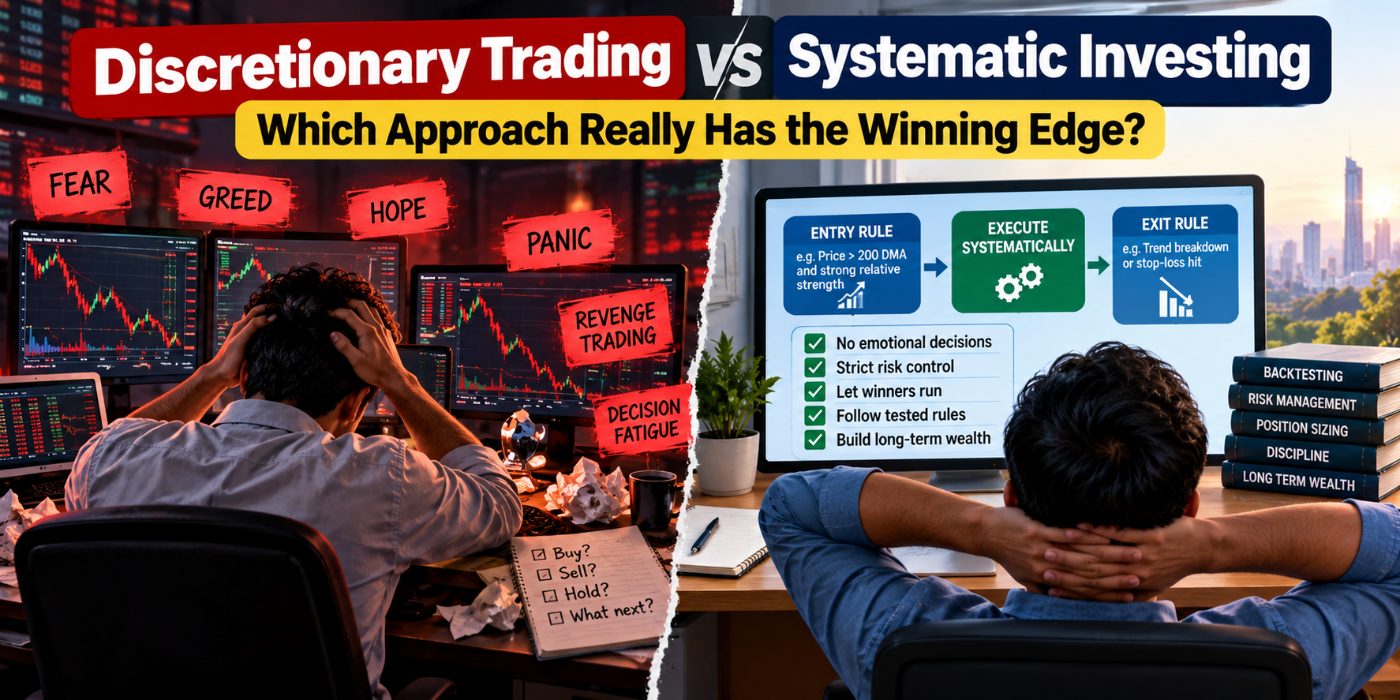
Walk onto any trading floor or browse any online forum, and you will quickly notice two entirely different philosophies of wealth creation.
On one side sits the discretionary trader—the person glued to live screens, reading breaking news, tracking hourly charts, and making split-second decisions based on gut feeling and intuition. On the other side sits the systematic investor—the individual who builds a set of strict, mathematically tested rules, steps back, and lets automated models or predefined plans execute the trades.
For decades, retail investors have debated which approach holds the true winning edge. To find out, we need to look past the excitement of live charts and examine how human psychology, risk control, and probability actually perform over long market cycles.
1. The Discretionary Trap: Why Gut Feeling Ultimately Fails
Discretionary trading relies entirely on human judgment in real time. While it sounds empowering to "trust your instincts," human biology is poorly wired for the stock market.
- The Loss Aversion Trap: When a discretionary trader buys a stock that starts crashing, emotional attachment kicks in. Instead of cutting the loss quickly, fear and hope conspire: "I'll wait until it bounces back to my purchase price." A small 5% error frequently balloons into a devastating 40% loss.
- The Fatigue Factor: Discretionary traders must make dozens of correct psychological choices every single week. After a grueling day of monitoring red and green candles, decision fatigue sets in, leading to revenge trading, impulsive entries, and emotional panic.
In discretionary trading, your worst enemy isn't the broader economy or sudden volatility. Your worst enemy is your own psychological blind spot.
2. What Is Systematic Investing?
Systematic investing completely removes real-time guesswork. Instead of asking, "How do I feel about this stock today?" a systematic investor relies on cold, mechanical rules established before a single rupee is put at risk:
- The Entry Rule: Buy only when a stock clears its 200-day moving average and relative strength ranks in the top decile.
- The Exit Rule: Automatically exit if the trend indicator turns negative or if the pre-defined stop-loss threshold is breached.
There is no hesitation, no bargaining with the market, and no second-guessing. The system dictates the action; you simply act as the disciplined executor.
3. Where the True Winning Edge Lies: Absolute Detachment
The ultimate, hidden edge in the financial markets has nothing to do with predicting the future. The edge belongs to those who trade with zero emotional attachment.
When you treat investing as a cold, mechanical business:
- You cut losses without ego: If a trade fails, you exit instantly because the rule demands it.
- You let profits compound: When a winning stock climbs month after month, you don't panic-sell out of fear that tomorrow's news might dip the price. You remain anchored until the system signals a natural trend breakdown.
By removing feelings, you stop fighting market reality and align your capital directly with statistical probability.
4. Rules, Discipline, and Probabilistic Expectancy
Success in the markets does not require a 100% win rate. Even the most robust systematic strategies encounter losing trades. The winning edge comes from mathematical expectancy:
- Controlled, Tiny Losses: Because your rules enforce strict stop-losses, your losing trades are managed paper cuts.
- Outsized, Scaled Winners: Because your rules keep you strapped into strong trends, your winning trades capture the bulk of the move.
When your average winner is significantly larger than your average loser, math and discipline ensure that your portfolio compounds steadily over time—even if fewer than half your trades hit the target.
How We Apply Systematic Principles at Sanjeev Research
At Sanjeev Research, we believe that long-term wealth cannot be built on emotional rollercoasters or spontaneous market tips.
Our research frameworks and Model Portfolios are entirely rule-based. By replacing human bias with objective data filters and letting systematic rules govern our portfolio allocation, we help investors step off the emotional treadmill and build wealth with absolute structure, discipline, and clarity.
Conclusion
If you want to survive and thrive in the stock market, stop trying to predict every twist and turn. Master your process instead. By shifting from emotional discretionary guessing to disciplined systematic investing, you transform the stock market from a stressful gambling arena into a reliable, repeatable engine for long-term wealth creation.

Why Your Emotions Are Costing You Money: The Power of Systematic Investing
Discover why systematic rule-based investing outperforms emotional discretionary trading. Learn how removing feelings, following strict rules, and trusting probability builds long-term wealth.

Why Smart People Make Dumb Money Moves: 4 Behavioral Traps That Destroy Portfolios
Discover the hidden psychological traps like loss aversion and herd mentality that ruin stock market returns. Learn real-world examples and how to protect your portfolio from emotional errors.

Mastering Quantitative Backtesting: How to Test Stock Trading Strategies Across Past Market Cycles
Discover the hidden flaws in stock trading backtests. Learn how to eliminate data repainting, account for circuit locks, track signal distribution, and apply these same quantitative principles to model portfolio construction.
Comments
Loading…