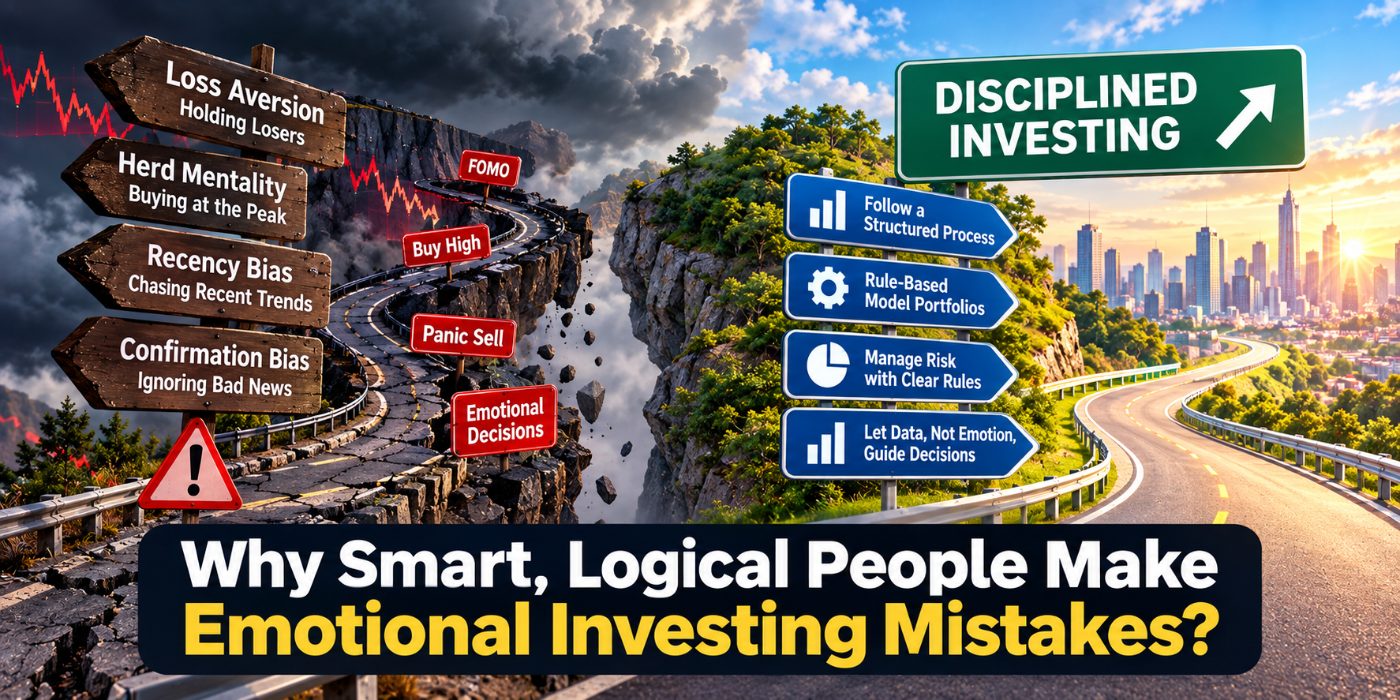
Have you ever noticed how brilliant, highly logical people—engineers, doctors, and scientists—can completely lose their common sense the moment they put money into the stock market?
A friend who meticulously researches every car purchase for three months will suddenly buy a random stock because a stranger on social media said it is going "to the moon." A professional who handles high-stakes business decisions daily will panic-sell a fundamentally sound stock just because the index dropped 2% on a Tuesday morning.
Why does this happen? The truth is, the stock market is not a math test; it is a giant psychological mirror. And the hardest thing to manage in finance isn't the charts—it's the human brain.
Behavioral finance studies show that our minds are wired with ancient survival instincts that are completely toxic to modern investing. Let's look at four psychological traps that silently drain retail portfolios, and how to fix them.
1. Loss Aversion: Why Holding Losers Feels Safer Than Cutting Them
In behavioral economics, studies (such as those by Nobel laureates Daniel Kahneman and Amos Tversky) prove that the pain of losing 10,000 rupees is psychologically twice as intense as the joy of making 10,000 rupees.
- The Real-Life Example: Imagine you buy a stock at 500 rupees. A month later, bad news hits the sector, and the stock drops to 350 rupees. Instead of admitting the trade went wrong and moving on, your brain screams: "It’s not a real loss until I sell! If I hold on, it will eventually come back to 500, and then I’ll exit."
- The Result: Months turn into years. That company's business model changes, debt piles up, and the stock drops to 100 rupees. You held on to avoid the psychological pain of a small loss, turning it into a catastrophic disaster.
The Fix: Treat every stock like a business employee. If an employee stops performing and starts draining resources, you don't keep them around hoping they'll change—you cut ties. Set your stop-loss or exit rule before you buy.
2. Herd Mentality: Buying at the Absolute Peak
Humans are tribal animals. For thousands of years, following the crowd meant staying safe from predators. In the stock market, however, following the crowd means running straight off a cliff.
- The Real-Life Example: Think back to the recent frenzy around speculative small-cap stocks or hyped-up sectors. When a stock doubles in a month, everyone at the office watercooler, family WhatsApp groups, and financial news channels is talking about it. You feel left out (a psychological feeling known as FOMO—Fear Of Missing Out). You buy in at the absolute peak, just as institutional investors and early buyers are quietly selling their shares to lock in profits. Within weeks, the hype fades, the stock crashes 40%, and you are left holding the bag.
- The Data Reality: Historical market data shows that retail volumes consistently peak right at market tops, meaning retail investors buy high out of excitement and sell low out of panic.
The Fix: If everyone around you is excitedly talking about a stock, your default reaction should be caution, not eagerness. True wealth is built by buying quiet, ignored, fundamentally sound assets, not by chasing crowded rallies.
3. Recency Bias: Assuming Yesterday’s Trend Lasts Forever
Recency bias is our tendency to believe that whatever is happening right now in the market is going to continue forever.
- The Real-Life Example: When the market goes through a raging bull run for 18 straight months, investors start believing that stocks only go up. They take on excessive leverage, stop checking balance sheets, and throw risk management out the window. Conversely, during a sharp two-week market correction, panic sets in. People vow "never to touch stocks again," liquidating their entire equity portfolios at a massive loss just days before a major market rebound.
The Fix: Zoom out. Look at 10-year or 20-year market charts. Markets move in cycles—bull runs, flat consolidations, and corrections are all normal seasons of the financial weather.
4. Confirmation Bias: Living in an Echo Chamber
Once we buy a stock, our brain instantly looks for reasons to prove we made the right choice.
- The Real-Life Example: You invest in a company. The next day, a financial analyst publishes a report warning that the company's management is shady and sales are slowing down. Instead of investigating the warning, you ignore it, dismiss the analyst as "clueless," and search Google specifically for articles or forum posts telling you why the stock is still a multi-bagger. You filter out critical facts because they challenge your ego.
The Fix: Actively try to prove why your investment thesis is wrong. If you can't find valid counter-arguments, your conviction is based on hope, not research.
How Sanjeev Research Helps You Beat Behavioral Traps
Understanding these psychological traps is easy; overcoming them in the heat of the moment is extraordinarily difficult. This is why human willpower alone is never enough.
At Sanjeev Research, we built our platform to remove human emotion from the equation entirely. By relying on objective, systematic screening, rule-based model portfolios, and predefined quantitative entry-and-exit frameworks, we eliminate the space where fear, greed, and confirmation bias can creep in.
When your process is mechanical and data-driven, you stop reacting to market noise and start executing like a disciplined professional.
Conclusion
The stock market is designed to transfer wealth from the impatient to the disciplined. By recognizing behavioral traps like loss aversion, herd mentality, and recency bias, you can stop fighting your own biology. Step off the emotional rollercoaster, rely on structured rules, and let discipline guide your financial journey.

Systematic Investing vs. Discretionary Trading: Which Has the Winning Edge?
Compare systematic investing and discretionary trading. Discover why emotion-free, rule-based systems provide a long-term winning edge over gut-feeling stock picking.

Why Your Emotions Are Costing You Money: The Power of Systematic Investing
Discover why systematic rule-based investing outperforms emotional discretionary trading. Learn how removing feelings, following strict rules, and trusting probability builds long-term wealth.

Should you average down a losing stock? Why a rules-based model won't
Averaging down feels smart and often isn't. Here's why adding to a losing position is so tempting, the risk it creates, and how a rules-based process avoids it.
Comments
Loading…