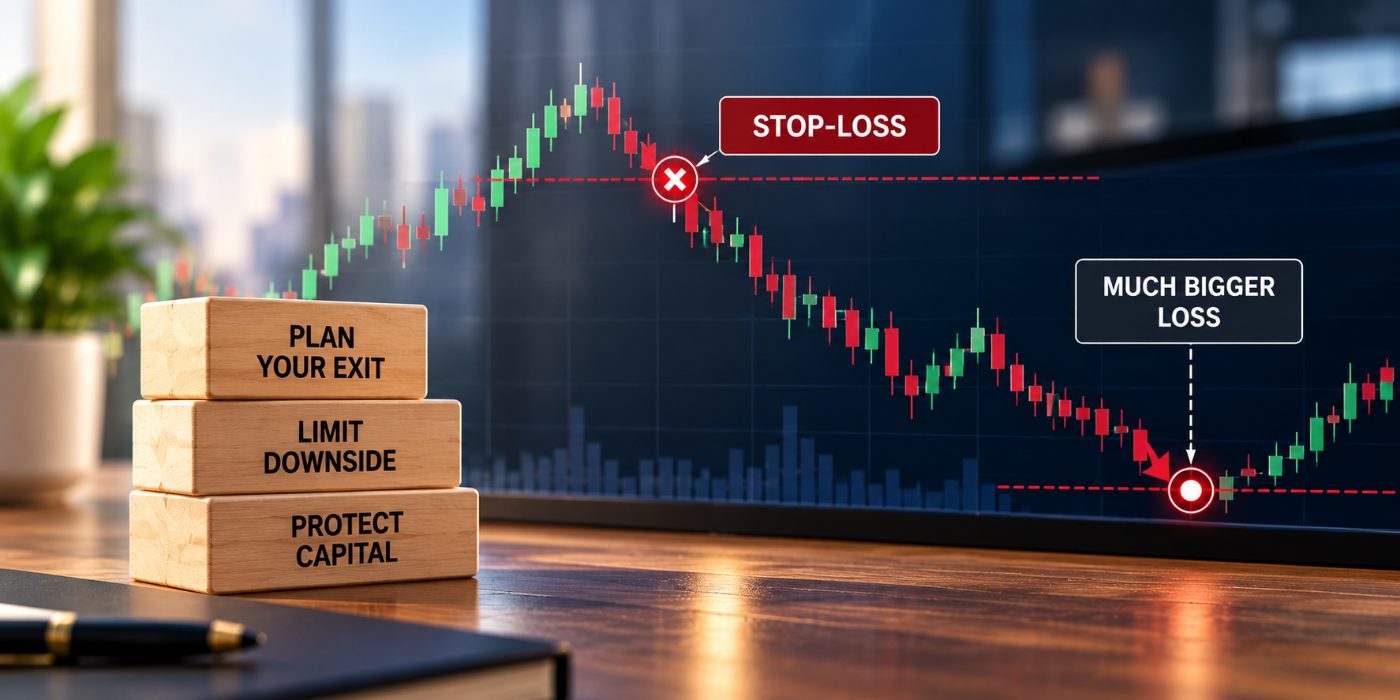
Ask any experienced investor what separates survivors from those who blow up, and many give the same one-word answer: the stop-loss. It's the simplest risk rule there is — and the most ignored. This is for learning only.
What a stop-loss is
A stop-loss is a price, decided in advance, at which you will exit a position to cap your loss. Buy a share at ₹100, set a stop at ₹92, and if it falls there you're out — your loss is limited to 8%, no arguing with yourself in the heat of the moment.
Why big losses are so dangerous
Here's the maths most people never see: a loss and the gain needed to recover it are not equal. The deeper the hole, the harder it is to climb out.
| If you lose | You need this gain just to break even |
|---|---|
| 10% | 11% |
| 25% | 33% |
| 50% | 100% |
| 75% | 300% |
| 90% | 900% |
A 10% loss is a small bruise. A 50% loss means your money must double just to get back to where it started.
Why a 75% loss needs a 300% gain — the maths
That "300%" looks strange, so here is the simple arithmetic behind it.
Say you start with ₹100 and lose 75%. You are left with just ₹25. To get back to your original ₹100, that ₹25 now has to grow back to ₹100 — and ₹25 growing to ₹100 is four times your money, which is a 300% gain. You lost 75% in one fall, but you need a 300% rise to undo it.
The rule behind the whole table is one small formula:
gain needed (%) = loss ÷ (100 − loss) × 100
Notice how the gain needed explodes as the loss deepens — it rises far faster than the loss itself. That is the whole reason to keep every loss small: a shallow hole is easy to climb out of, but a deep one can be almost impossible. Cutting losses small matters far more than being right often.
How big should your stop-loss be?
There is no single "right" distance. Too tight and normal day-to-day wiggles throw you out of a good position; too loose and you lose more than you needed to. Three things should decide how far below your price the stop sits.
1. How volatile the stock is. A jumpy, high-volatility stock can move 4–5% on an ordinary day. Put a tight 2% stop on it and you'll be "stopped out" by normal noise again and again — even when nothing is actually wrong. Such stocks need a wider (deeper) stop so they have room to breathe. A calm, low-volatility stock that barely moves 1% a day can take a tighter stop, because a 2–3% fall there already signals that something has changed. In short: match the stop to how much the stock normally swings. (To keep your rupee risk the same, a wider stop simply means taking a smaller position — see what is position sizing.)
2. How much leverage you're using. Leverage — borrowed money, or F&O — magnifies every move, so a small fall in the stock becomes a big loss on your money. Leveraged, quick-trade positions are built for fast, small wins, so they need a tight, small stop-loss: you simply can't afford to let a leveraged trade drift against you. The more leverage, the tighter and stricter the stop. (And remember — SEBI's data shows most leveraged F&O traders lose money; leverage cuts both ways, hard.)
3. How long you plan to hold. If you're a long-term investor holding for months, use a wider stop — you want to ride out the normal ups and downs without being shaken out by a passing dip. If you're taking a short-term or leveraged position aiming for a quick gain, use a tight stop — the whole point is to exit fast if it doesn't work.
Put it all together and the pattern is simple: wider stops for calm, long-held positions; tighter stops for volatile, leveraged, short-term ones. The stop should fit the stock and the trade — not be the same number every time.
The discipline part
A stop-loss only works if you actually honour it. The hardest moment in investing is admitting a position isn't working and exiting while the loss is small. SEBI's own studies have shown that around 9 in 10 individual F&O traders lose money — and a big reason is letting small losses snowball because they refuse to exit.
The point of a stop-loss isn't to be right. It's to make sure that when you're wrong, you're only a little wrong. Protect your capital first; the profits can wait. For more, read intraday trading vs positional investing.
Why a 50% loss needs a 100% gain: the drawdown maths that humbles everyone
Losses and gains aren't symmetric. A 50% fall needs a 100% rise just to break even — the brutal arithmetic of drawdowns, and why avoiding big losses matters most.
Rebalancing: the quiet habit that keeps your portfolio from drifting
Over time your winners grow and quietly take over your portfolio, raising risk without you noticing. What rebalancing is, how it works, and how often it helps.

Should you average down a losing stock? Why a rules-based model won't
Averaging down feels smart and often isn't. Here's why adding to a losing position is so tempting, the risk it creates, and how a rules-based process avoids it.
Comments
Loading…