SEBI Investor Survey 2025
India’s retail investment story is often presented as a rapid transformation.
Millions of new investors have entered the stock market. Mutual fund SIPs have become mainstream. Trading apps have made investing easier than ever. Financial content has exploded across YouTube, Instagram and other digital platforms.
But the latest SEBI Investor Survey 2025 presents a more nuanced picture.
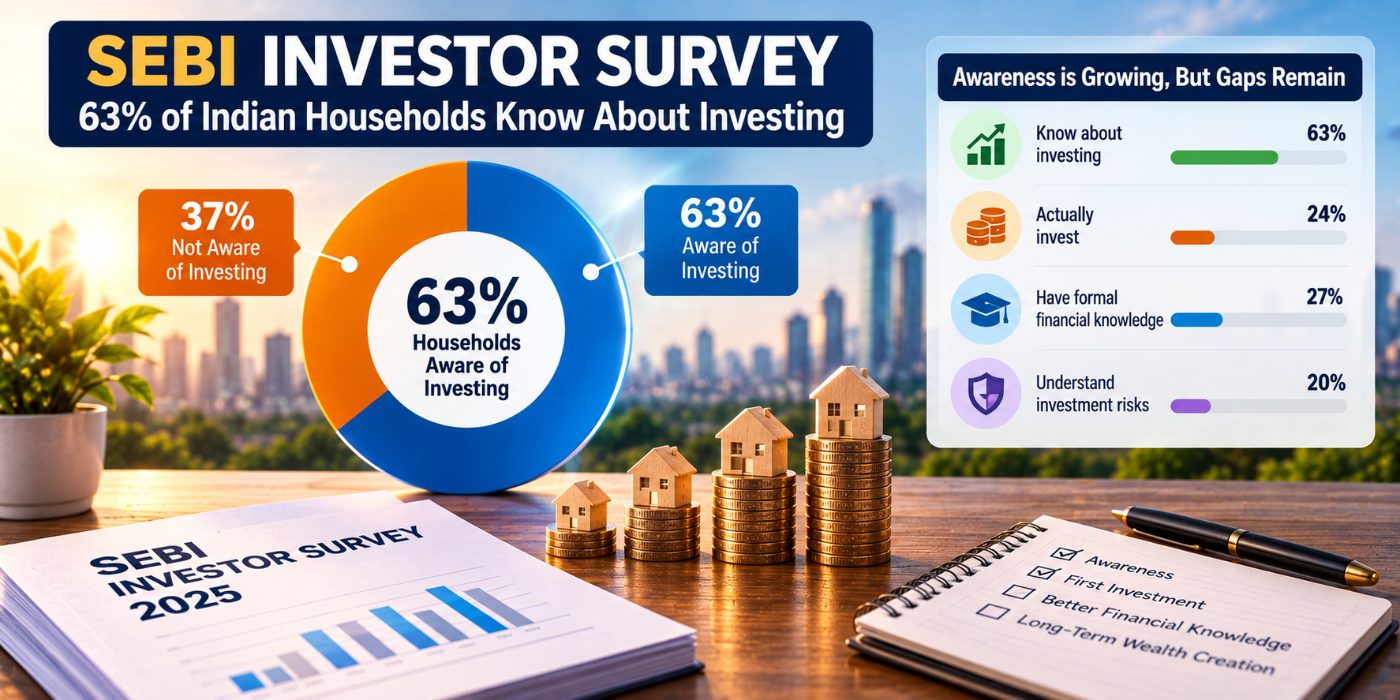
A majority of Indian households are now aware of securities-market products. Yet only a small fraction actually invest.
According to the survey, 63% of Indian households are aware of at least one securities-market product, but only 9.5% actually invest in the securities market.
That leaves a huge gap between awareness and participation.
And that gap may represent one of the biggest opportunities — as well as challenges — for the next phase of India’s financialisation.
Awareness is rising, participation remains limited
India has approximately 33.72 crore households.
SEBI's survey estimates that around 63% of households are aware of securities-market products, while only 9.5% participate as investors.
The difference is striking.
People know that stocks, mutual funds and other market-linked products exist. But awareness alone isn't translating into investment.
The question is: Why?
The answer appears to involve a combination of risk, lack of knowledge, complexity and trust.
Mutual funds lead the way
Among households that participate in securities markets, mutual funds are more widely used than direct equity.
Approximately:
- 6.7% of households invest in mutual funds
- 5.3% invest directly in stocks
Participation in more complex products remains much lower.
This suggests that India's retail investment story is not simply about a boom in stock trading.
It is increasingly about the broader financialisation of household savings, with mutual funds playing a particularly important role.
Indian households remain highly conservative
One of the most interesting findings of the survey challenges the popular image of the new Indian investor.
Around 80% of households have low risk tolerance, while only a small minority demonstrate high risk tolerance.
Similarly, around 80% of households prioritise preservation of capital.
This is important because financial-market conversations on social media can create the impression that Indian retail investors are increasingly comfortable with high-risk products and speculative trading.
The survey suggests otherwise.
For most households, avoiding the loss of their savings remains more important than maximising returns.
The biggest opportunity may be the people who haven't invested yet
Perhaps the most encouraging finding is that many non-investors aren't permanently opposed to investing.
Among non-investors who are already aware of securities products, 22% say they intend to invest within the next year.
This points to a potentially large pool of future investors.
But converting awareness into participation will require more than simply giving people access to another investment app.
People need to understand what they are buying, how much risk they are taking and whether a particular product is appropriate for them.
Knowledge remains a major hurdle
SEBI's survey suggests that investor knowledge remains relatively limited.
Only around 36% of investors demonstrate moderate or high knowledge of the securities market.
That means a significant proportion of people who are already investing may still have limited understanding of market products.
This becomes particularly important when investment decisions are increasingly influenced by digital content.
Finfluencers have become a major force
Financial influencers are no longer simply an awareness channel.
They can influence actual investment decisions.
SEBI's survey found that around 62% of investors make some or most investment decisions based on recommendations from financial influencers.
This is a significant development.
On one hand, financial creators can make investing easier to understand and bring market information to people who may otherwise never engage with it.
On the other hand, when investors have limited financial knowledge, the influence of recommendations can create risks.
The distinction between financial education and financial advice therefore becomes increasingly important.
India still has a large urban-rural divide
Participation in securities markets also varies significantly by geography.
Around 15% of urban households participate, compared with only about 6% of rural households.
The gap becomes even more visible in India's largest metropolitan areas, where participation reaches approximately 23%.
This suggests that the next wave of retail participation may increasingly come from smaller cities and rural India — provided barriers around knowledge, trust, accessibility and financial awareness can be addressed.
What investors actually want
The motivations for investing are relatively straightforward.
Among investors surveyed:
- 72% cite high growth potential
- 58% cite income generation
- 51% cite diversification and risk mitigation
So investors aren't necessarily looking for speculation.
They are looking for a combination of wealth creation, income and protection through diversification.
The bigger story: India has an investor-conversion problem
The SEBI survey changes the way we should think about India's retail investment opportunity.
The problem is not simply that Indians don't know about the stock market.
They do.
The bigger challenge is converting:
Awareness → Knowledge → Confidence → Participation
Today, the first step has progressed considerably.
The remaining steps are much harder.
A household may know what a mutual fund is but still hesitate to invest.
Someone may have heard of equities but not understand volatility.
A young investor may follow financial content every day but still struggle to distinguish education from a recommendation.
And a potential investor may have money available but prefer bank deposits because preserving capital feels safer.
What this means for India's next investment cycle
The next stage of India's retail investment growth may therefore depend less on simply attracting people to financial markets and more on building investor confidence and financial capability.
That could mean:
- simpler explanations of financial products
- better investor education
- greater availability of regional-language content
- clearer communication of risks
- improved awareness of investor rights
- greater scrutiny of financial recommendations on social media
The opportunity is enormous.
But the SEBI survey also makes one thing clear:
India's next 10 crore investors will not necessarily be created by more trading apps. They may be created by better financial education.
The bottom line
India has moved a long way from a time when the securities market was relevant only to a small section of households.
But the journey is far from complete.
63% awareness versus 9.5% participation tells the story better than almost any other statistic in the survey.
India doesn't merely need more investors.
It needs better-informed investors who understand risk, products and their own financial objectives.
That may ultimately determine how sustainable the country's retail-investing boom becomes.
Source: SEBI Investor Survey 2025.
Comments
Loading…