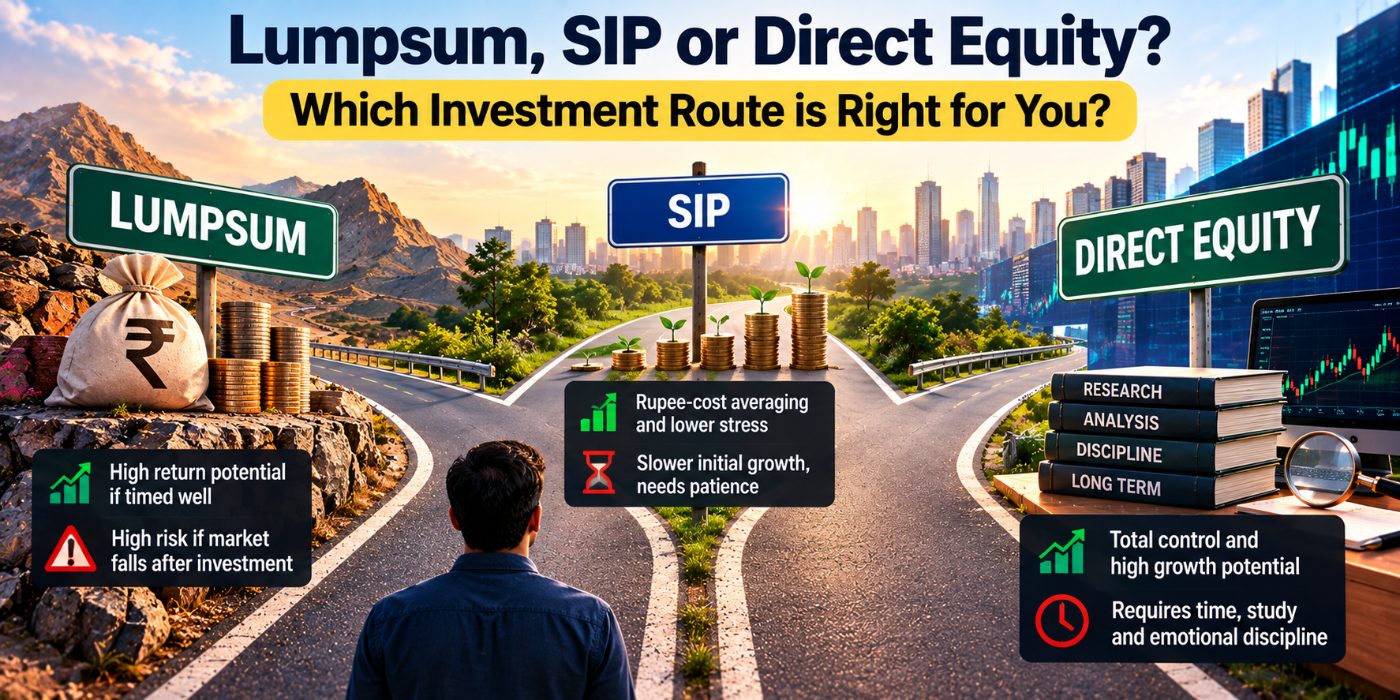
When planning your financial future, one of the most critical decisions you will make is how to deploy your capital. Walk into any financial forum, and you will see passionate debates about whether to drop a lump sum into mutual funds, automate a monthly SIP, or build a direct stock portfolio.
The truth is, there is no universal "best" route. Each strategy comes with its own distinct set of advantages, disadvantages, and risk profiles. Understanding these trade-offs is the first step toward aligning your investments with your personal objectives and temperament.
1. Lumpsum Investment: The Timing Dilemma
A lumpsum investment involves deploying a large amount of capital into the market all at once.
- The Advantage: If you manage to invest right at the bottom of a major market correction, a lumpsum investment can feel like hitting a financial lottery, generating massive compounding returns as the market rebounds.
- The Risk: Timing the market is notoriously difficult—even for professional fund managers. If you invest a large lumpsum right before a market downturn or a sharp correction, your portfolio takes an immediate, heavy hit. It requires strong psychological endurance to watch your capital shrink right after deployment.
2. Systematic Investment Plans (SIP): The Power of Disciplined Averaging
For most retail investors who don't have large idle capital or the time to time the market, a Systematic Investment Plan (SIP) is a far more practical vehicle.
- How It Works: You invest a fixed amount regularly (e.g., monthly) into a chosen fund theme with the belief that the underlying thesis will play out over the next 5 to 10 years.
- The Advantage: SIPs leverage rupee-cost averaging. When the market is down, your fixed amount buys more units; when the market is up, it buys fewer. This naturally lowers your average purchase cost over time without the stress of market timing.
- The Risk: Because capital is deployed gradually, returns can be slower during raging bull markets compared to an early lumpsum investment. It demands patience and long-term commitment.
3. Direct Equity: Total Control Requires Total Dedication
Direct equity means buying individual company shares directly through a demat account.
- The Advantage: You enjoy complete transparency, zero ongoing management fees, and the potential for exponential returns if you identify high-growth structural winners early.
- The Risk & Commitment: This route is not for casual hobbyists. Succeeding in direct equities requires dedicating yourself to rigorous research, studying chart patterns, evaluating balance sheets, and understanding price action. If you lack the time or inclination for deep study, direct stock picking can lead to severe underperformance.
4. Summary: Weighing the Three Routes
| Strategy | Ideal For | Major Advantage | Key Risk / Drawdown |
|---|---|---|---|
| Lumpsum | Investors with high risk tolerance and cash ready | High return potential if timed well | High vulnerability to market timing errors |
| SIP | Long-term planners and busy professionals | Built-in rupee-cost averaging, low stress | Slower initial capital growth, requires patience |
| Direct Equity | Dedicated researchers and active traders | Total control, zero management fees | Demands intense study, time, and emotional discipline |
How Sanjeev Research Bridges the Gap
Many investors find themselves at a crossroads: they want the direct ownership, transparency, and growth potential of equities, but they don't have the time to build and monitor an individual stock basket from scratch.
This is where a structured Model Portfolio provides a balanced alternative. At Sanjeev Research, our Model Portfolio is engineered to mitigate single-stock risk through clear structural safeguards:
- Max 40 Stocks: A carefully curated basket capped at a maximum of 40 stocks to ensure meaningful diversification without over-diluting returns.
- Equal Weighting: Capital is distributed equally across holdings. This ensures that no single company's failure can cripple your portfolio, while giving every winner equal room to contribute.
- Diversified Exposure: Holdings are intentionally spread across unrelated sectors and market capitalizations, distributing market risk evenly across economic cycles.
Conclusion
The best investment route isn't the one with the highest historical return on paper; it is the one that matches your capital availability, time commitment, and psychological comfort. Know your objectives, understand the risks, and choose a disciplined framework that keeps you on track for the long run.
Comments
Loading…