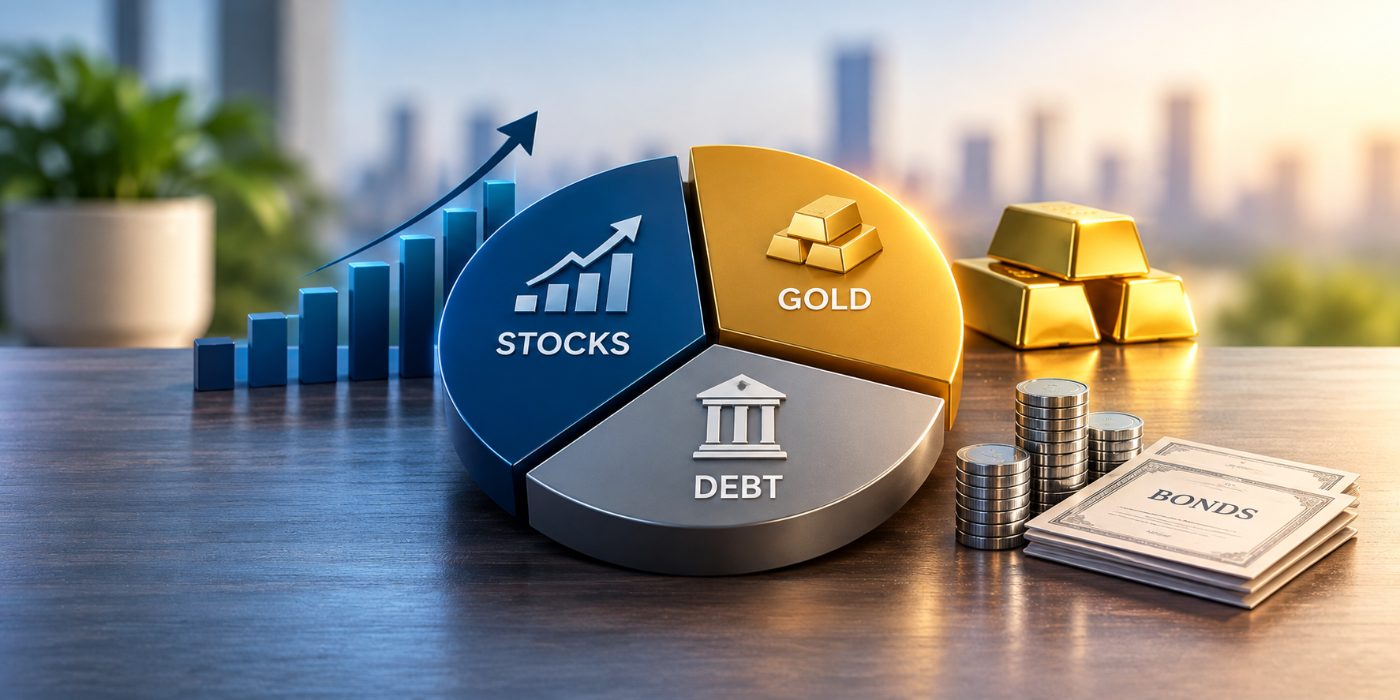
Studies over decades keep finding the same thing: how you split your money across asset types matters more than which exact stock or fund you pick. That decision is called asset allocation. Here's how to think about it simply. This is for learning only.
The three basic buckets
- Equity (stocks / equity funds): the growth engine. Highest long-term return (~12%), but bumpy.
- Debt (FDs, bonds, debt funds): the shock absorber. Steady (~6–7%), low risk.
- Gold: the insurance. Tends to do well exactly when stocks struggle (~9–10% long-term).
Because these three don't all rise and fall together, holding a mix makes your overall journey smoother — when one zigs, another often zags.
A simple starting rule
A classic rule of thumb: keep roughly (100 minus your age)% in equity, and the rest in safer assets. It's not a law — just a sensible anchor:
| Age | Equity | Debt | Gold |
|---|---|---|---|
| 25–30 | 70% | 20% | 10% |
| 40 | 60% | 30% | 10% |
| 55+ | 40% | 50% | 10% |
Younger people can take more equity because they have time to ride out falls. As you near a goal (retirement, a house), you shift toward safety so a sudden crash can't derail you.
Why it works — a quick picture
Imagine a year when stocks fall 20% but gold rises 15%. A 100%-equity investor is down 20% and scared. A 60/30/10 investor is down far less and can stay calm — and calm investors don't sell at the bottom. Avoiding panic is itself a return.
The one habit that completes it
Once a year, rebalance — sell a little of what grew too big and top up what shrank, to return to your target split. It quietly forces you to "sell high, buy low" without any guesswork.
Getting the split right, then holding it with discipline, is the backbone of sensible investing — and it's why we treat the Model Portfolio as a whole basket with a plan, not a pile of separate tips.
Gold and crude oil: how commodities fit into an investor's thinking
Gold is near record highs and crude oil swings with world events. In simple words: why people invest in commodities, how gold and oil behave, and the risks to know.

How many stocks should a portfolio hold? The maths of diversification
Too few stocks and one blow-up ruins you; too many and you can't track them. The research-backed sweet spot for how many stocks to hold — and the simple maths behind it.
The cost of timing the market: miss a few big days and your returns collapse
Jumping in and out to dodge falls sounds smart. The maths says otherwise — missing just a handful of the market's best days can wreck a decade of returns.
Comments
Loading…